


Introduction
Since the public introduction of Generative Intelligence, commonly known as Gen AI, in November 2022, hardly any aspect of our lives has remained untouched by this technology.
Given these developments, how could the U.S. immigration application process, particularly Extraordinary Ability petitions, remain disconnected from the current reality of Gen AI integration?
It has not.
In the high-stakes world of U.S. immigration, the EB1A Extraordinary Ability green card is often considered the “gold medal” of visas. In the pre-Gen AI era, securing approval meant months of manual effort, from tracking thousands of citations to drafting dense technical narratives and attempting to establish ‘major significance’ before a USCIS officer who may not have deep expertise in the applicant’s field.
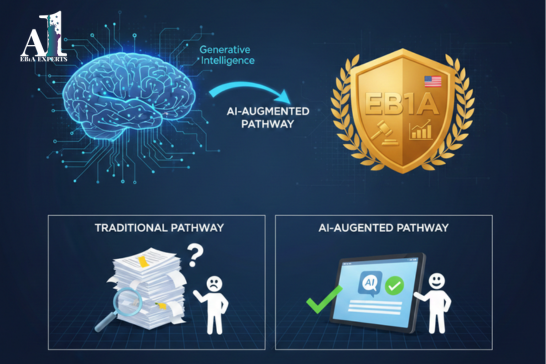
As we approach the end of 2025, a new standard has emerged: the AI-augmented EB1A pathway. Generative intelligence is no longer a buzzword. It has become a practical assistive tool, helping top-tier professionals, from AI researchers to biotech engineers, shorten timelines while improving approval outcomes.
How does AI help in identifying EB1A Evidence?
One of the first hurdles any EB1A applicant faces is Evidence Mapping. Given how critical well-mapped evidence is to strengthening a petition, applicants often spend an enormous amount of time gathering, organizing, refining, and aligning their materials to satisfy at least three of the ten USCIS criteria. This process can be exhausting and, at times, demoralizing.
However, when Gen AI is strategically integrated as an assistive tool, this once onerous process becomes far more manageable. AI tools are transforming evidence identification from a guessing game into a data-driven process. Here are several ways Gen AI can be effectively used in the EB1A application journey:
- Citation Deep-Dives: Instead of manually reading every paper that cites you, AI-powered engines (like those used by leading firms) can scan global databases to find “impactful citations”, especially instances where an independent researcher specifically highlights your method as a ‘breakthrough’ rather than just a footnote.
- Gap Analysis and Critical Feedback: Generative models can compare your current profile against a database of thousands of successful USCIS decisions and provide critical feedback by flagging instances where your ‘Judging’ criteria is weak or if your ‘Original Contribution’ lacks the necessary documentary proof. This allows you to bridge those gaps before you file.
- Automated Exhibit Indexing ‘Pro Max’: AI can now categorize hundreds of pages of evidence, ensuring every award, publication, and press clip is cross-referenced perfectly with the legal brief. This makes things more sorted and structured.
Narrative Synthesis and The “Layperson” Test
One of the most common reasons for a Request for Evidence (RFE) is the inability of USCIS officers to comprehend the technical importance of the applicant’s work.
The reason is straightforward. Many petitions are overloaded with technical jargon, making them difficult for a layperson to follow.
It is extremely important to remember that the adjudicating officer is not a subject-matter expert. Simplifying the technically complex concepts and presenting them in an accessible language is critical.
This is where Generative AI shines.
Gen AI can function as a ‘narrative bridge’ by taking highly technical concepts, like ‘multi-modal neural architecture’, and transforming them into persuasive ‘layperson’ prose that demonstrates the National Importance of your work.
Comparison: Tradition Pathway Vs. AI-augmented Pathway
| Feature | Traditional Pathway | AI-Augmented Pathway |
| Drafting Speed | 4-5 Weeks | 5–7 Days |
| Evidence Context | Manual, anecdotal | Semantic and data-backed |
| Technical Clarity | Risk of jargon-heavy text. Takes time and effort to make the text more comprehensible for a layperson. | Tailored for non-expert officers. Requires not more than a few seconds. Just give a prompt and your work shall be done. |
| Consistency | Human error in cross-referencing | Algorithmic precision. Note: Human oversight is required as the AI models tend to hallucinate. |
It is evident from the above table that the AI-augmented pathway offers a strategic advantage as it reduces drafting time, improves evidence context, and minimizes inconsistencies, aligning your petition closer to the evaluation criteria employed by USCIS.
A Few Words of Caution:
It is a well-known fact that integrating Gen AI into a process makes it less draining and more time-saving. Using Gen AI tools can boost drafting efficiency by 40-60%.
But there’s a catch:
Gen AI is not a “magic wand.” There are a few things you need to keep in mind while employing Gen AI:
- Gen AI tends to hallucinate: Gen AI inherently tends to hallucinate or invent claims that are not factual. Therefore, it is crucial that every claim made by a generative tool be verified against hard documentary evidence. Leaving any loopholes can complicate the process.
- Keep Human-in-the-Loop: The most successful petitions in 2025 made use of the “Human-in-the-Loop” model. AI can be used to generate the framework, but a qualified immigration attorney can refine the legal strategy to ensure it meets the Kazarian Final Merits Determination.
- Fraud Detection: Just as applicants are readily using AI, USCIS is deploying its own AI systems to detect fraud and generic patterns that indicate AI use. Authenticity remains the ultimate currency.
Conclusion: Make Strategic use of Gen AI to Ensure Success
The EB1A category remains highly selective, but your success today depends on both effort and strategy. You must align strong, verifiable evidence with clear, layperson-friendly storytelling and objective standards of evaluation.
When you use Gen AI strategically, it helps you identify high-impact evidence, translate complex work for non-expert adjudicators, and present your case with greater precision and consistency. It does not replace your legal judgment or credibility; it strengthens them when every claim is carefully reviewed and backed by hard facts.
As scrutiny increases and adjudication standards continue to evolve, the AI-augmented EB1A pathway gives you a decisive edge. By combining intelligent technology with rigorous human oversight, you place yourself in the strongest position to present a compelling and credible case for extraordinary ability.
Extraordinary ability deserves extraordinary presentation.
If you want to understand how AI-driven evidence mapping and narrative synthesis can strengthen your EB1A petition, take the next step: Schedule a profile review with EB1A Experts and see how a data-backed strategy can improve your approval odds.