
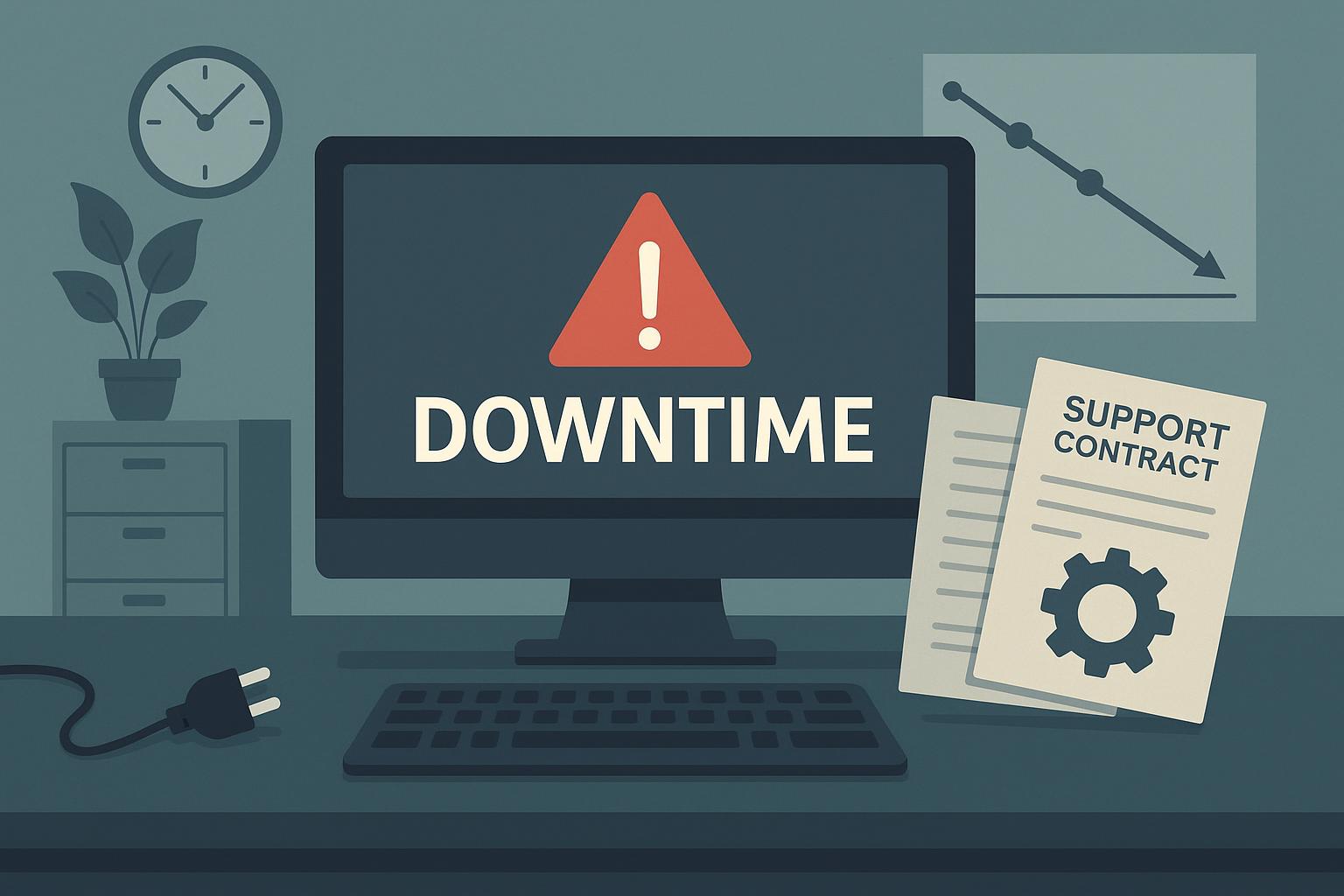
Every small business owner has been there. The network goes down, the point-of-sale system freezes, or nobody can log into anything, and suddenly the entire operation grinds to a halt. Employees stand around checking their phones. Customers get frustrated. Revenue quietly leaks out of the business while everyone waits for someone, anyone, to fix the problem.
What most owners don’t realize is just how expensive those hours really are. Downtime is not just an inconvenience. It is one of the largest hidden costs in modern business, and it hits small companies harder than anyone else. This is exactly why so many growing businesses are moving away from the old “call someone when it breaks” model and toward structured business IT support contracts that prevent problems before they ever reach the bottom line.
Let’s break down what downtime actually costs, why the numbers are worse than most people assume, and how the right support agreement changes the math.
Downtime Is More Expensive Than You Think
When business owners estimate the cost of downtime, they usually calculate it in a very simple way: revenue per hour multiplied by hours offline. If your business brings in $500 an hour and you’re down for three hours, that’s $1,500 lost. Painful, but survivable.
The problem is that this calculation dramatically understates the real damage. Here’s what it leaves out:
Idle payroll. Your team still gets paid during downtime. If you have ten employees earning an average of $30 an hour, a three-hour outage burns $900 in wages for work that simply didn’t happen. That cost exists whether or not a single customer transaction occurs.
Recovery and repair costs. The fix itself often costs more than the outage. Emergency IT work is expensive. Technicians charge premium rates for urgent calls, and if data has been corrupted or lost, restoration efforts can stretch across days.
Customer churn. A customer who walks out because your systems are down rarely comes back. Studies on customer behavior consistently show that even one bad experience pushes a significant percentage of customers toward a competitor. That lost lifetime value never shows up on a downtime invoice, but it’s real money.
Reputation damage. In the age of online reviews, an outage is public. A frustrated customer with 2,000 followers and a bad experience can shape public perception of your business for years.
Employee morale and burnout. Constant firefighting wears people down. Staff who spend their days working around broken systems get frustrated, and frustrated employees leave. Turnover is one of the most expensive line items any business has.
When you stack all of these factors together, industry research puts the average cost of IT downtime for small and mid-sized businesses somewhere between $427 and $9,000 per minute depending on the sector. Even taking the conservative end of that range, a single afternoon outage can easily cost a small business more than an entire year of proactive IT support.
Why Small Businesses Get Hit Hardest
There’s a common assumption that downtime is mostly an enterprise problem. Big companies have more systems, so more things can break. In reality, the opposite is true, and the reason comes down to redundancy.
Large organizations build resilience into their infrastructure. They have backup servers, failover internet connections, redundant power, and entire teams monitoring systems around the clock. When something fails, another component takes over, often before users even notice.
Most small businesses have none of that. You have one internet connection, one server (or one cloud account nobody fully understands), and one person who “knows computers” and gets pulled away from their actual job whenever something goes wrong. There is no redundancy, no monitoring, and no documented recovery plan. A single failed piece of hardware can take the whole company offline.
Small businesses also tend to defer maintenance. Updates get postponed because everyone is busy. Aging hardware stays in service because replacing it hasn’t felt urgent yet. Old software keeps running because migrating seems like a headache. Every one of those deferrals is a small bet that nothing will break, and eventually that bet loses.
The Hidden Downtime You’re Not Counting
Here’s something that surprises a lot of owners: the biggest source of productivity loss isn’t the dramatic full outage. It’s the slow drip of small, untracked interruptions.
The employee who spends 25 minutes every morning fighting with a sluggish laptop. The manager who can’t access the shared drive and works around it for a week. The printer that jams so often that someone walks documents to a copy shop. The email filter that eats legitimate customer inquiries.
None of these events show up as “downtime” in anyone’s ledger, but they add up to enormous losses over a year. If each of your ten employees loses just 30 minutes a day to technology friction, you’re losing 125 hours of productivity every month. That’s more than three full-time weeks of labor, gone, quietly, without a single incident report.
This slow bleed is precisely what reactive, break-fix IT arrangements never address. A technician only gets involved when someone finally raises a flag, and by then the cost has already been paid.
How Support Contracts Change the Equation
A structured IT support contract, often called managed IT services, works on a fundamentally different model than break-fix support. Instead of paying per disaster, you pay a predictable monthly fee for ongoing care. That shift sounds simple, but it changes everything about how downtime affects your business.
Proactive monitoring catches problems early. Managed support includes continuous monitoring of servers, networks, and devices. Many issues, like a failing hard drive or a server running out of storage, show warning signs days or weeks before they cause an outage. Catching those signs early turns a catastrophic failure into a scheduled repair that happens after hours with zero business impact.
Patches and updates happen on time. Under contract, routine maintenance isn’t something that gets squeezed in when there’s time. It’s part of the service. Systems stay current, secure, and compatible, which eliminates one of the biggest causes of unplanned outages.
Faster response when things do break. Support contracts come with defined response times, often measured in minutes rather than days. Because the provider already knows your environment, has documentation on file, and has remote access tools in place, resolution happens dramatically faster. A problem that might take an ad-hoc technician six hours to diagnose often gets fixed in one.
Fewer problems in the first place. This is the part that really matters. Businesses on proactive support arrangements report significantly fewer support tickets over time, not just faster resolution. When someone is actively maintaining your systems, the steady drip of small interruptions slows to a trickle, and all those untracked productivity losses start coming back to the business.
Predictable budgeting. Break-fix IT is financially chaotic. Some months cost nothing, and then a server failure lands a $6,000 invoice with no warning. A support contract converts unpredictable emergency spending into a flat, forecastable monthly expense, which makes financial planning genuinely easier.
A Quick Way to Run Your Own Numbers
You don’t need a consultant to estimate what downtime is costing you. Try this rough exercise:
- Add up your hourly revenue (total annual revenue divided by 2,000 working hours).
- Add your hourly payroll cost for all employees.
- Estimate your realistic downtime hours per year, including the small daily interruptions, not just the memorable outages.
- Multiply, and add a rough factor for recovery costs and lost customers.
Most owners who run this exercise honestly are startled by the result. Then compare that annual figure against the cost of a support contract. In the vast majority of cases, the contract costs a fraction of what unplanned downtime already does.
The Bottom Line
Downtime is not a rare disaster that might happen someday. For businesses running on reactive IT, it’s a recurring expense that’s already being paid, just in a form that never appears on an invoice. Every idle hour, every workaround, every lost customer, and every emergency repair bill is part of the price.
Support contracts don’t eliminate every technical problem, and no honest provider will claim they do. But they systematically remove the most common causes of downtime, catch the rest earlier, and fix what remains faster. For a small business, that combination often represents the single highest-return investment available in the entire technology budget.
The question worth asking isn’t whether your business can afford proactive IT support. Given what downtime actually costs, it’s whether you can keep affording its absence.