
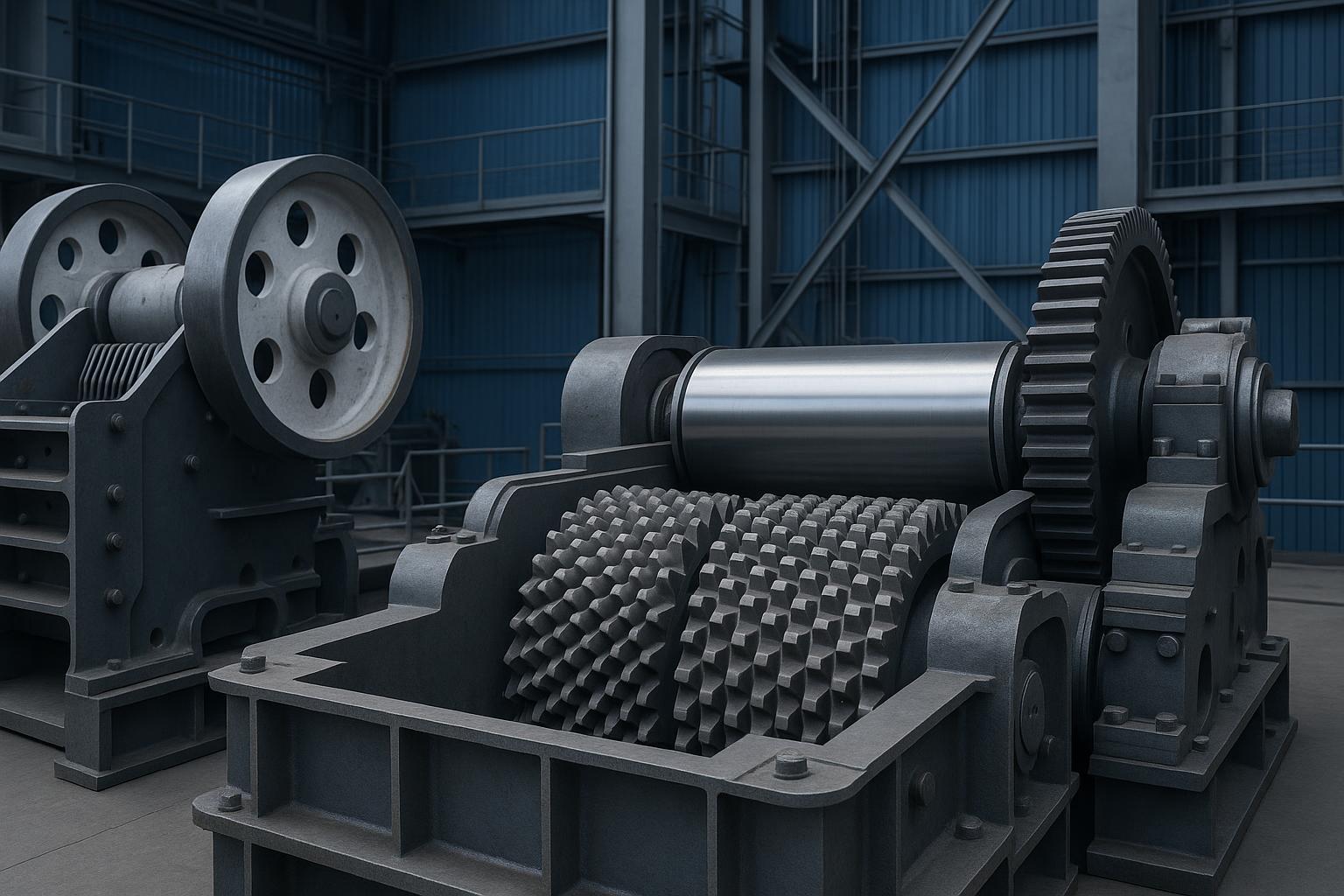
Efficiency in the aggregate-to-pavement workflow starts at the crusher and finishes under the drum. Modern quarries and recycling yards process raw rock and reclaimed materials into specification-ready aggregates by using integrated plants centred on the stone crusher, smart material flow-but the real gains come from designing crushing and rolling as a single, optimized system rather than two separate trades.
Reinventing “crush then compact” as a closed loop
Too many projects think of crushing and compaction as discrete steps: rock gets reduced to size, screened, hauled, and then much later compacted. A closed-loop approach looks at target particle shape, gradation and fines content required by the pavement engineer and works backwards-selecting crusher types, screening curves and roller strategies that together produce durable, compactable layers with minimal rework. This reduces fuel, truck cycles and variability in in-place density.
Choosing the right crusher family for the job
One-size crushing does not exist. The primary reduction is usually done with compressive-type machines, which produce a high throughput and a coarse product. Secondary and tertiary crushing stages are used for producing cubical particles and controlling fines for workability. Knowing the exactitudes of the friction, longevity, physics and mechanics of the crushers enables you to find the right crusher for the right material.
By preventing rolling over incompatible material, you avoid both shoddy work and breaking the bank in purchasing a machine that isn’t useful for a while.
Feed and screening play the pivoting role.
Consistent feed rate and appropriate screening strategy is the best friend of both crushing efficiency and downstream compaction. A plant that controls feed gradation and removes deleterious fines prior to asphalt production achieves uniform density with fewer roller passes. Mobile plants, or pre-screening at the pit, can also eliminate unnecessary double handling, which saves trucking and energy. Practical rule of thumb: design the crushing circuit to deliver the target grading curve at the plant gate, not to rely on field correction later.
Where the jaw fits – and how to get more from it
Rough duty, rugged and uncomplex, a good jaw crusher serves as a workhorse for primary reduction-tolerant of tramp material. Reciprocating motion and toggle mechanics give them a pretty decent action in breaking large, blocky feed down to a size that will readily enter the next stages of crushing, refinement of shape, or fines production-in particular, cone or impact stages. A combination of a jaw with surge hoppers, vibration feeders, and wear-monitoring programs will increase uptime and product consistency-minor changes, but ones that lower downtime and stabilize feed to later crushing stages.
Integrating crushing output with compaction strategy
Crushers can be tuned to produce gradations that compact efficiently. Such as, the production of a little more coarse-to-medium fractions can decrease binder demand and improve stiffness; however, it requires rollers and compaction sequences able to densify larger particle mixes. Mixes with a higher proportion of fines need care with moisture and roller selection to avoid over-compaction and pumping.
Matching of rollers to material and layer function
The selection of roller should be informed by the processed aggregate. Vibratory drums are the new order of the day for bases and asphalt binder courses, where the dynamic energy required to rearrange particles and expel air voids; kneading action provided by pneumatic-tyred rollers helps in interlocking the surface fines and achieving a smooth finish; static rollers are useful for finishing and lighter compactive effort. Application of intelligent compaction sensors on rollers allow real-time feedback about stiffness and pass counts so crews can hit density targets with fewer redundant passes.
Environmental and economic benefits of an integrated approach
By making these calls together, you can reclaim more on-site material, reduce haul distances, and optimise fuel consumption across the asset lifecycle. A plant configuration that takes into account gradation and energy costs is also very likely to meet local sustainability and green requirements, which saves you a hefty fine in the long run.
Practical checklist:
- Define target gradation and compaction specification before setting up plant.
- Choose a crushing sequence that optimizes particle shape VSI/cone when cube is critical.
- Stabilise feed to primary crushers with surge hoppers and feeders; monitor wear parts.
- Screen in order to fractionate materials to give each layer the correct mix of coarse and fines. Select roller types and compaction patterns for produced gradation and lift thickness; record IC data where available.
Final thought
Crushing and rolling are two halves of the same engineering coin. Given the practice of treating quarry, plant, and paving train as a system, where the stone crusher output is specified for compaction capability, the jaw crusher tuned for steady predictable feed, and compaction equipment is chosen to make the most of the produced gradation, it has ultimately released performance, sustainability, and cost gains which no one-off optimisation can ever achieve. In short: design, monitor, and tweak the whole chain so that the drum does less in order to get a longer-lasting pavement-and that drum is the road roller.